
INSTRUMENTATION CABLE

Instrumentation Cables are specialized cables built to carry low-energy electrical signals. They're essential for monitoring and controlling systems, particularly in industrial settings. These cables reliably transmit data, signals, and control information from various instruments and devices to control panels and other equipment.

Filters

0 Products

FIlters

Have Questions?

Call Us. Icon

Call Us.

(833) 268-8644

Email Us

Instrumentation Cables are specialized cables designed to transmit low-energy electrical signals for monitoring and controlling systems, especially in industrial environments. They reliably carry data, signals, and control information from various instruments and devices to control panels and other equipment. Unlike power cables, they are engineered for sensitive measurement and control signals rather than electrical power.

Instrumentation cables are crucial because they ensure accurate, reliable, and interference-free signal transmission in electrically noisy industrial environments. Even minor electrical interference can lead to incorrect readings and operational problems in critical systems. Their specialized construction, including shielding and twisted pairs, protects sensitive signals from electromagnetic interference (EMI) and radio frequency interference (RFI).

While both are used in industrial settings, Instrumentation Cables and Control Cables serve different primary purposes.

  • Instrumentation Cables: Designed to transmit low-voltage, low-current analog and digital signals for measurement, monitoring, and data acquisition. They prioritize signal integrity and protection from interference.
  • Control Cables: Primarily used for transmitting power signals to control or operate machinery and devices, often handling higher power tasks. They are optimized for power distribution and direct equipment control.

Shielding is vital for protecting sensitive signals from external electromagnetic interference (EMI) and radio frequency interference (RFI). Common types include:

  • Foil Shield: Offers 100% coverage, excellent for high-frequency noise, lightweight, and cost-effective, but can be mechanically weaker.
  • Braid Shield: Provides good mechanical strength and flexibility, effective for low- to mid-frequency interference, typically with 70-95% coverage.
  • Combination Shielding: Utilizes both foil and braid for maximum protection against a broad range of interference and enhanced mechanical durability.
  • Individual Pair Shielding: Each twisted pair has its own shield, providing maximum protection against crosstalk between circuits, ideal for multiple independent signal paths.
  • Overall Shielding: A single shield surrounds all conductors, suitable for low-frequency analog signals in moderate EMI environments.

Selecting the correct instrumentation cable involves considering several factors:

  • Signal Type: Identify if it's analog (e.g., 4-20mA, thermocouple, RTD) or digital (e.g., RS-485, Fieldbus). Analog signals typically require shielded twisted pairs.
  • Electrical Noise Environment: In areas with high EMI (motors, VFDs), individually shielded pairs or combination shielding are recommended.
  • Installation Environment: Consider temperature, moisture, chemical exposure, and UV radiation; choose appropriate insulation and jacket materials.
  • NEC Rating: Determine installation location (e.g., cable tray - PLTC or TC, plenum space - CMP).
  • Conductor Size: Typically 16-18 AWG for analog loops and general instrumentation.

Instrumentation cables are widely used in industries requiring accurate, reliable, and interference-free transmission of control and measurement signals. Common applications include:

  • Process Control Systems: In chemical plants, refineries, and pharmaceutical facilities, connecting sensors (temperature, pressure, flow) to control systems.
  • Industrial Automation: Facilitating communication between sensors, controllers, and automated machinery in manufacturing.
  • Data Acquisition: Transmitting signals from measurement devices to data logging systems in research and testing facilities.
  • Power Generation and Distribution: Monitoring and controlling electrical systems in power plants and substations.
  • Building Management Systems: For various monitoring and control functions within commercial buildings.

These terms refer to the configuration of conductors within the cable, designed to enhance signal integrity:

  • Pairs: Consist of two insulated conductors twisted together. This twisting helps cancel out electromagnetic interference through balanced signal transmission, commonly used for analog signals.
  • Triads: Consist of three insulated conductors twisted together. Triads are typically used for 3-wire RTD (Resistance Temperature Detector) circuits, where the third conductor compensates for lead resistance, ensuring more accurate temperature measurements.
Call Us. Icon

Call Us.

(833) 268-8644

Email Us

INSTRUMENTATION CABLE

Looking for an agile US distributor that sells electronic control and instrumentation cable by the foot? Wire America is a leading industrial cable supplier, providing bulk Instrumentation Cable with premium shielding cut to length with fast shipping to keep your automation and process control systems moving seamlessly.

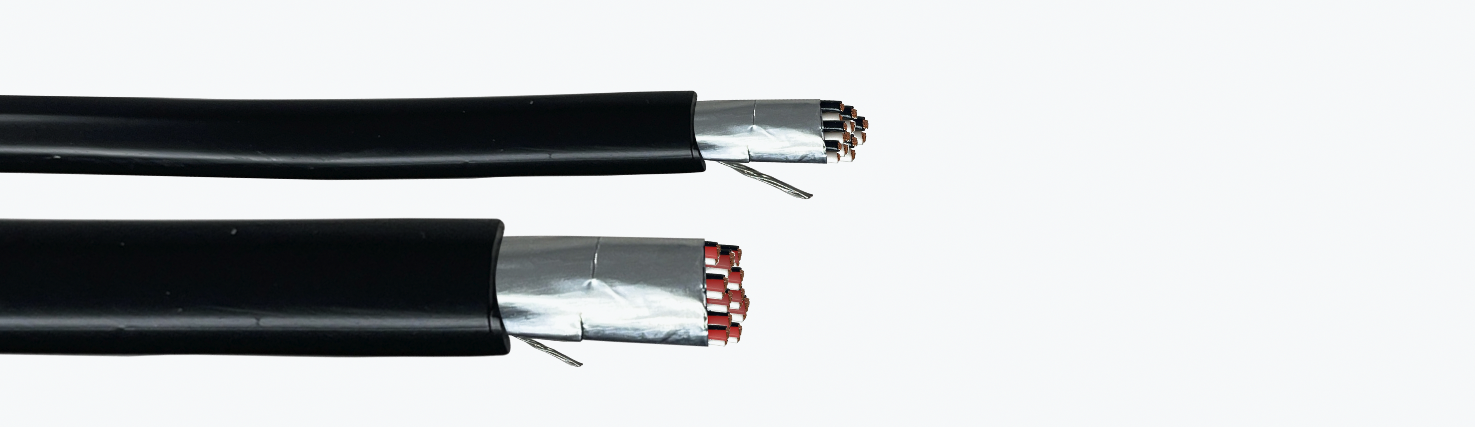
Engineered to safeguard low-voltage analog and digital signals against electromagnetic interference (EMI), our inventory features multi-conductor, paired, and triad configurations with overall aluminum-mylar foil shields and tinned copper drain wires. Fully carrying dual-ratings as Type PLTC and TC-ER, these 300V and 600V cables are officially code-approved for exposed runs, cable trays, and raceways in harsh industrial environments. 

Instrumentation Cables are signaling cables designed to transmit clean, accurate data in industrial process control and automation systems.  They utilize specialized shielding—either an overall shield for general protection or individually shielded pairs for maximum isolation between signals. With rugged jackets rated for sunlight resistance and direct burial, these cables ensure the precision of your flow meters, pressure transducers, and PLC inputs in even the harshest environments.

Installation Note: To ensure maximum noise rejection, the shield and drain wire should typically be grounded at one end only (usually the controller or PLC end). Grounding at both ends can create a "ground loop," which may actually introduce the very electrical noise you are trying to eliminate. When stripping the cable, take care not to nick the insulation of the twisted pairs, as this can lead to signal leakage or intermittent faults in sensitive 4-20mA loops.
Key Features
  • Shielding Options: Available in Overall Shield (OS) for basic noise rejection or Individual & Overall Shield (SPOS) to prevent "crosstalk" between adjacent pairs.
  • Twisted Pair/Triad Construction: Conductors are twisted to cancel out electromagnetic noise and improve signal-to-noise ratios.
  • Tinned Copper Drain Wire: Includes a continuous drain wire for easy grounding of the foil shields, ensuring effective EMI/RFI drainage.
  • PLTC & ITC Rated: UL listed as Power Limited Tray Cable (PLTC) and Instrumentation Tray Cable (ITC), allowing for installation in cable trays and raceways.
  • Flame & Chemical Resistance: Encased in a durable PVC or XLPE jacket that is sunlight resistant and designed to withstand industrial oils and chemicals.
  • 600V or 300V Ratings: Available in multiple voltage classes to suit specific control system architectures and safety requirements.
  • High-Purity Stranded Copper: Utilizes soft-annealed stranded copper for flexibility during installation and reliable conductivity.
Common Applications
  • Process Control Systems: Connecting field sensors (temperature, pressure, level) to Distributed Control Systems (DCS) or PLCs.
  • Refineries & Chemical Plants: Providing reliable signaling for hazardous area instrumentation and valve actuators.
  • Water Treatment Facilities: Routing data from remote flow sensors and chemical monitors to central control hubs.
  • Power Generation Plants: Used in turbine control systems and electrical substation monitoring.
  • Mass Transit Signaling: Wiring for trackside sensors and communication systems in rail networks.
  • Automated Assembly Lines: Connecting encoders and proximity sensors to high-speed robotic controllers.
  • Laboratory & Medical Equipment: Ensuring high-fidelity data transmission for sensitive analytical instruments.

Resources & Guides

Foil Shielding in Wire & Cable | 100% EMI Coverage Guide
February 10, 2026
Read More about Foil Shielding in Wire & Cable | 100% EMI Coverage Guide
What is UL 1277? The Standard for Type TC-ER Tray Cable
February 04, 2026
Read More about What is UL 1277? The Standard for Type TC-ER Tray Cable