
BARE COPPER WIRE

Bare Copper Wire is, as its name suggests, copper wire that has no insulation or protective coating. It's highly prized for its excellent electrical conductivity, making it a staple for applications like grounding, everyday residential wiring, and any other scenario where minimal electrical resistance is a top priority. Depending on the specific requirements of the job, bare copper wire is available in different physical forms, such as solid, stranded, or tinned.

Filters

0 Products

FIlters

Have Questions?

Call Us. Icon

Call Us.

(833) 268-8644

Email Us

Bare copper wire is most commonly used for grounding and bonding in electrical systems, as well as overhead transmission, tracer wire, and jumper applications. Because it has no insulation, it is not used for current-carrying circuits inside walls.

The difference lies in the temper and flexibility of the metal:

  • Soft Drawn (Annealed): This copper has undergone a heat-treating process to make it highly flexible and easy to bend by hand. It is the industry standard for grounding and bonding in residential and commercial electrical work.
  • Hard Drawn: This copper retains its structural stiffness and high tensile strength from the drawing process. It is highly resistant to stretching, making it ideal for overhead spans where the wire must support its own weight over distances without sagging.

Your choice depends on the wire size and how much physical flexibility your installation requires:

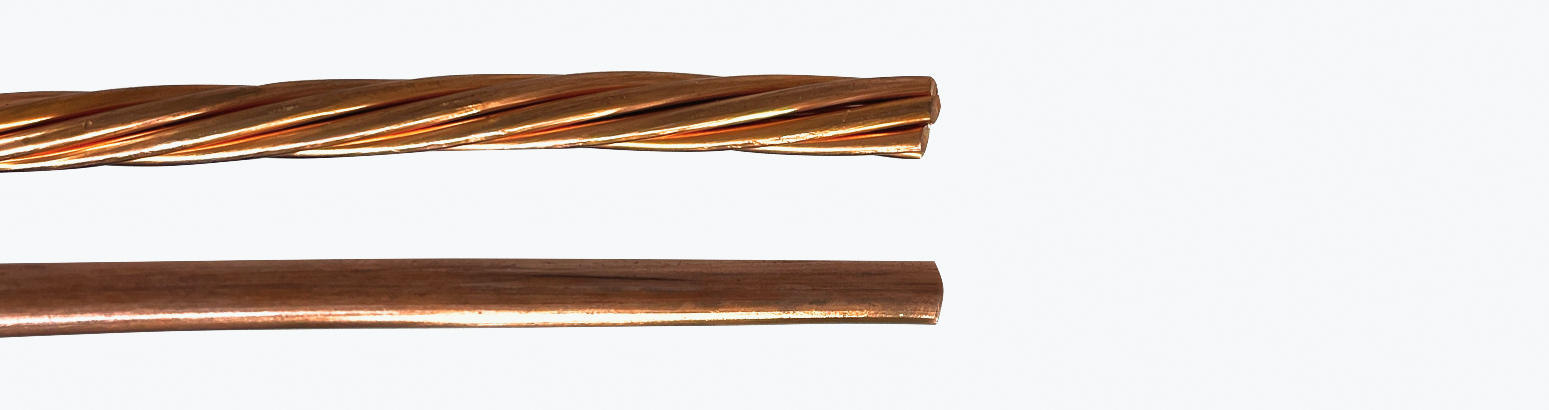
  • Solid Bare Copper: A single, solid strand of copper. It is highly rugged, provides excellent surface area for grounding clamps, and is standard for smaller gauges (like 8 AWG and 10 AWG).
  • Stranded Bare Copper: Composed of multiple smaller copper strands twisted together. This design significantly increases flexibility, making it much easier to pull, bend, and route through tight enclosures or conduit—especially in larger gauges.

Tinned copper features a microscopic layer of tin alloy over the copper strands. While standard bare copper is highly corrosion-resistant in normal conditions, tinned copper is essential for environments exposed to extreme moisture, soil acidity, industrial chemicals, or saltwater. The tin coating prevents the copper from oxidizing (which turns it green and reduces conductivity), drastically extending the life of the grounding system.

Yes. Wire America is a leading supplier of bare copper wire, and we provide custom cut-to-length options by the foot for sizes 10 AWG up to 1000 MCM so you can order the exact length your project requires. (Note: Smaller gauges like 12 AWG and 14 AWG are sold in standard pre-packaged spool lengths).

We process and pack your orders rapidly, offering fast and reliable nationwide shipping with standard orders typically delivered to your job site within 2-4 business days. Expedited shipping options are available on the checkout page.

Call Us. Icon

Call Us.

(833) 268-8644

Email Us

Bare and Tinned Copper Wire

Bare and tinned copper wire serve as the foundation for electrical grounding and high-conductivity applications across residential, commercial, and industrial sectors. Bare copper offers maximum electrical and thermal conductivity, making it the industry standard for grounding systems and bonding. In contrast, tinned copper features a thin coating of tin over the copper core, providing enhanced protection against oxidation and corrosion—essential for marine environments or high-moisture settings. Both varieties are available in solid or stranded configurations; solid wire provides a rigid, stable form for permanent installations, while stranded wire offers the flexibility required for applications subject to vibration or frequent movement.
Key Features
  • High Conductivity: Manufactured from 99.9% pure soft-drawn copper for optimal electrical and thermal performance.
  • Corrosion Resistance: Tinned copper options feature a protective layer that prevents oxidation and simplifies soldering in humid environments.
  • Versatile Construction: Available in Solid (for rigidity and ease of termination) and Stranded (for superior flexibility and vibration resistance).
  • Temper & Hardness: Offered in "soft-drawn" or "annealed" tempers to ensure the wire is easy to work with while maintaining structural integrity.
  • Standards Compliance: Meets or exceeds ASTM B-1, B-3, and B-8 specifications for electrical conductors and grounding.
Common Applications
  • Electrical Grounding Systems: Used as a primary grounding electrode conductor for residential and commercial service entrances.
  • Lightning Protection: Ideal for bonding systems and lightning rod installations to safely dissipate electrical surges.
  • Marine & Coastal Wiring: Tinned copper is preferred for boat wiring and coastal infrastructure to resist salt-air corrosion. 
  • Utility & Power Distribution: Used in overhead distribution systems and for grounding transformer enclosures.
  • Industrial Equipment Bonding: Essential for grounding machinery and equipment to prevent static buildup and ensure operator safety.
  • Circuit Board Components: Finer gauges of tinned copper are used in lead wires for resistors, capacitors, and other electronic components.
  • Automotive & Solar Grounding: Frequently utilized in solar array racking systems and automotive battery grounding straps.

Resources & Guides

Defining Bare Copper Conductors: A Guide to Tempers and Construction
January 26, 2026
Read More about Defining Bare Copper Conductors: A Guide to Tempers and Construction
What is Annealed Copper? Why it’s the Secret to High-Performance Wiring
January 19, 2026
Read More about What is Annealed Copper? Why it’s the Secret to High-Performance Wiring
What is Tinned Copper? Why Professionals Choose It Over Bare Copper
January 19, 2026
Read More about What is Tinned Copper? Why Professionals Choose It Over Bare Copper